What the calculator measures
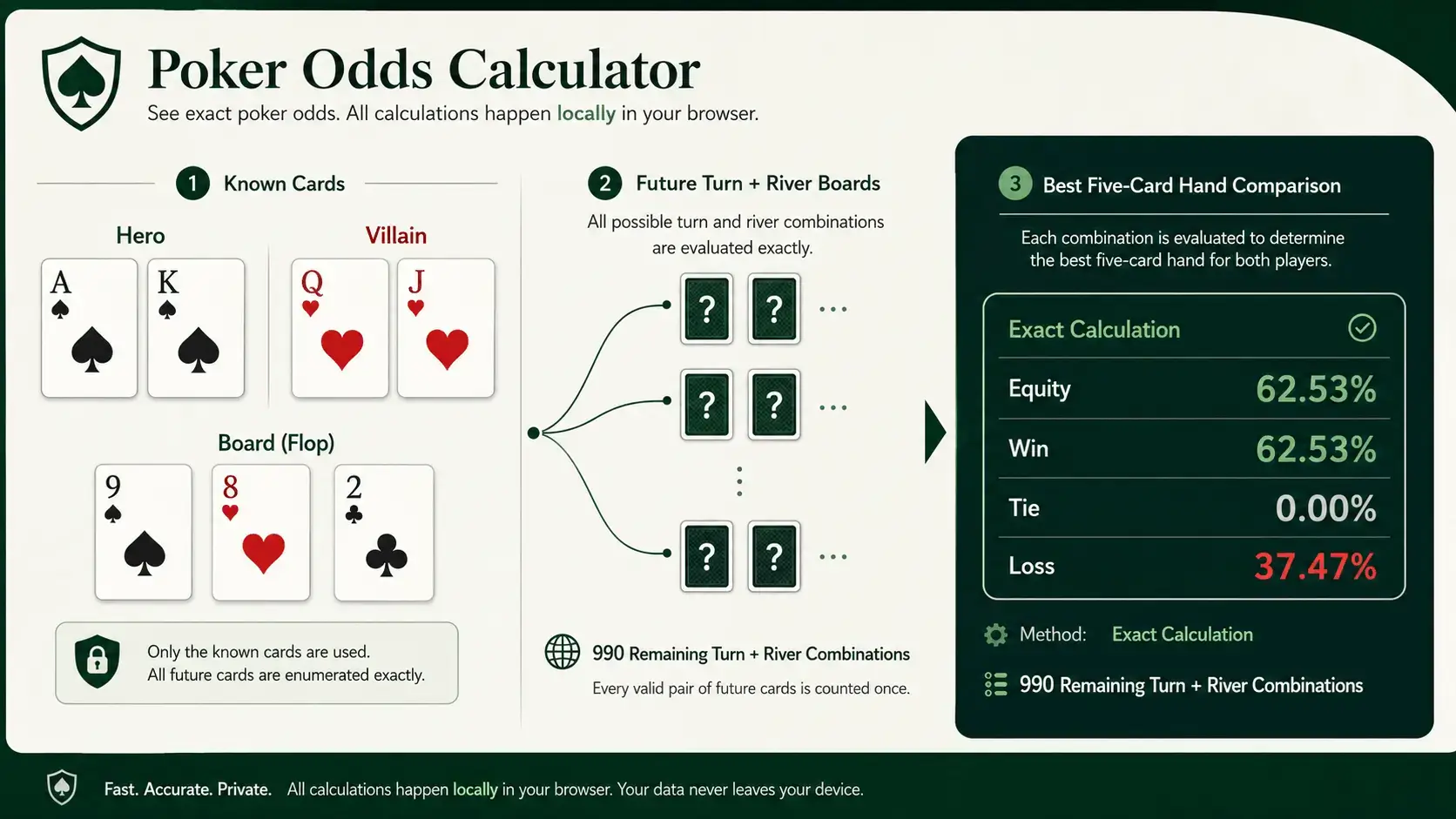
Win percentage counts boards where one player owns the sole best five-card hand. Tie percentage counts boards with shared winners. Equity divides each tied pot equally, so a three-way tie contributes one third of an outcome to each winner rather than a full win.
Every completed board is scored under the selected rule set. The percentages retain full floating-point precision in downloads even though the interface rounds them for reading.
Exact enumeration or seeded simulation
A flop or turn usually leaves few enough runouts to enumerate every unordered board completion. Preflop spaces are much larger, so Auto switches to Monte Carlo. A seed fixes the pseudo-random sequence: identical inputs, iteration count, and seed reproduce the same estimate.
The simulation interval describes sampling uncertainty around the estimate. It does not predict whether the next real deal will land inside that interval.
Exact hands and uniformly random hands
Choose Exact hand when both hole cards are known. Choose Random hand for an unknown opponent whose two cards should be sampled uniformly from every legal combination left in the 52-card deck. Known hole cards and board cards act as blockers before a random hand is dealt, and multiple random players draw from one shared deck without replacement.
A random hand is a neutral baseline, not a prediction of how a particular opponent plays. It gives equal treatment to every remaining two-card combination and does not model position, folds, opening frequency, or weighted ranges. Keep at least one Exact hand so the comparison answers a concrete question; use the Range Equity Calculator when different holdings need strategic weights.
Reading multiway equity responsibly
Adding players changes both clean winning paths and the frequency of chopped pots. Compare equity rather than win rate alone when ties matter. The model knows only the cards supplied; it does not infer ranges, folds, rake, future action, or player skill.
Worked examples
Overpair against a flush draw
Load the example after a three-card flop. Exact mode enumerates every legal turn-river pair once, including boards that counterfeit a pair or complete both players’ draws.
Board plays for everyone
Choose a five-card royal flush on the board with unrelated hole cards. Every player ties, win rates remain zero, and equity is divided evenly.
Frequently asked questions
Why can equity differ from win percentage?
Equity includes each player’s fractional share of tied outcomes; win percentage counts only sole wins.
When is the result exact?
Exact mode visits every legal missing-board combination. The result is exact only for the entered cards, players, and rules.
How is a Random hand selected?
Each simulation samples two cards uniformly from the deck after all Exact hands and known board cards are removed. Random players and the missing board share that deck, so no physical card can appear twice.
What does a Monte Carlo seed do?
It initializes the local random generator so the same simulation can be reproduced.
Are my hole cards uploaded?
No. Selection, calculation, sharing, and file export run in this browser. A share URL contains cards only after you request it.
Continue with the right tool
Share Poker Odds Calculator
Send the localized homepage and its share preview to another poker enthusiast.